


Although they are entertaining to use in their own special way and make excellent conversation starters, folding phones are not very useful.
Let us examine some of its disadvantages that would prevent the majority of people, including us, from purchasing one.
Unusual aspect ratio: Not ideal for consuming content
Whether you get a book style foldable or a flip foldable is irrelevant. They all have odd aspect ratios on their displays. For example, the Z Fold 6’s cover screen and the Z Flip 6’s main screen both have a 22:9 aspect ratio.
Displays on conventional phones are 19.5:9. The screens of folding phones are narrower but taller.
The smaller screen feels a little strange to someone who likes to watch YouTube videos and browse through Instagram Reels.
Those large black bars on a square-ish display would annoy me just as much as book style folding phones, which would be better for media consumption due to their enormous inner screens. With a regular phone, you do not have to worry about that.
The screen protector comes off
Unlike traditional glass, folding phones are prone to scratches and come with plastic screen protectors pre-installed to prevent damage.
More significantly, after months of deterioration, they feel cheap and appear unsightly.
The plastic screen protector begins to peel off at the crease after months of folding and unfolding the phone every day, and the damage worsens with time.
Positively, if your phone is under a year old, Samsung will replace the screen protector at no cost.
Poor cameras: Images and videos appear mediocre at best.
Given their high price tags, you would think that after a few years of existence, folding phones’ camera hardware would have advanced to the point where it is on par with flagship slab phones.
The slimmer profile of folding phones makes it difficult to fit larger camera sensors and lenses into a thinner chassis.
Being able to fold and take selfies with the primary cameras helps to mitigate the issue of the front facing selfie camera being the worst camera on most folding phones.
The crease is difficult to adjust to
The crease is hardly noticeable when the phone is first unboxed, but it becomes more noticeable after a few days of folding and unfolding.
After the first week, though, it has not gotten much worse. So, Samsung deserves the credit it deserves.
Poor battery life: Their lifespan is shorter than that of slab phones
This might be a deal breaker, but folding phones can not make as good use of the internal space as slab phones if you value all day battery life.
The hinge mechanism, which forces manufacturers to use a split battery design, is the primary cause.
Due to their compact design and emphasis on thickness, flip style folding phones have a lower battery life.
Also, having several screens makes it difficult to accommodate a larger battery without possibly sacrificing heat dissipation.
The future of folding phones is still far off
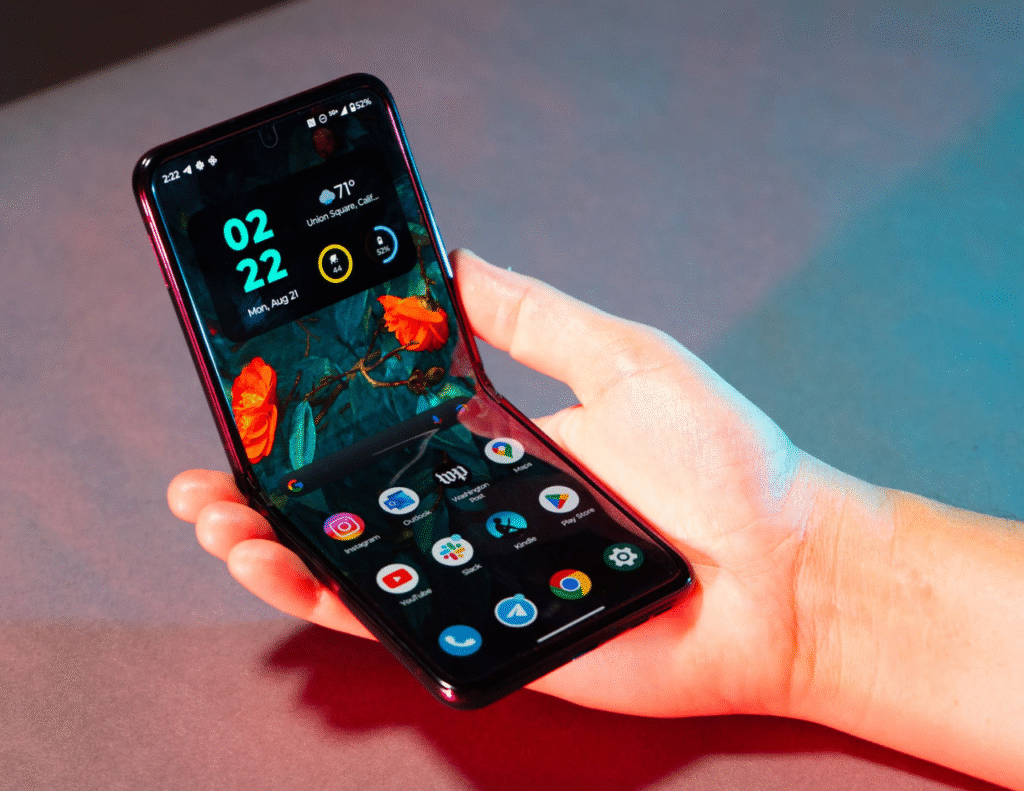
Folding phones are not as innovative as they once were in 2025. Even with the rise in popularity of this form factor and the resolved issues, the technology has not advanced to the point where we would trade in a traditional flagship phone for a foldable.
Since book-style folding phones fall short of high-end slab phones in crucial areas like durability, battery life, and camera quality, we still do not understand why they cost over Lakhs.
Once the novelty of owning one wears off, it is difficult to ignore the obvious disadvantages.







How to Make the Internet Safe for Your Children
Since the internet has become an essential part of communities all over...
 easyupdatemedia2 Mins read
10 Everyday Tasks AI Will Replace by 2030
According to predictions, artificial intelligence will subtly change daily life by 2030,...
easyupdatemedia2 Mins read
Top Chrome Extensions to Boost Your Efficiency
The Chrome Store is a vast collection of extensions that can do...
easyupdatemedia2 Mins read

How AI Assistants Are Replacing Virtual Assistants
The emergence of virtual assistants with artificial intelligence (AI) has significantly changed...
easyupdatemedia2 Mins read



Leave a comment